You cannot grow without open standards
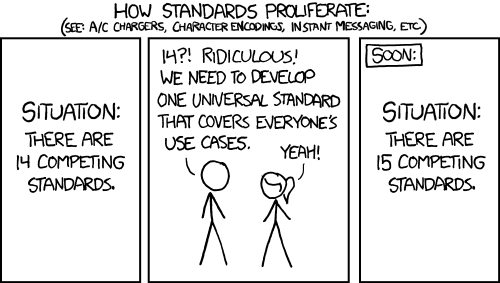
Many people think that Open Source software is some weird academic, socialist software thing. "Real businesses" make money by protecting their intellectual property, not giving it away.
Unless you plan to dominate the world and set your own standards, here are some pain points that open specifications address.
- You cannot import data from partners because they only provide PDFs (Portable Document Format) which is not really editable and very hard to process. Many vendors actively try to prevent you from accessing their data without authorization (code obfuscation, anti scraping terms etc.)
- Exporting your data to partners is a custom project every time because each one wants to have data in a different format or is skilled in a different technology.
- There is no scalability in your relationships with partners because everything is a custom integration. Imagine you allow people to connect to you on different technical levels, based on their technical maturity? That sounds interesting right? Many people can now integrate much faster with you and grow with your business.
- You cannot integrate with or access other partner's clients. The traditional approach means everybody recruits their own clients. With an integrated approach, you can sell services under another brand. If you think this approach sounds too liberal and won't make money, have a look at some of the biggest companies around like Google, Quandl and Atlassian. As a matter of fact, when somebody has a marketplace, they are selling third party services to their clients.
From a customer perspective, standards will become the only way to acquire software.
- Clients completely understand that having multiple software solutions, each one with its own usernames and passwords (and security policies), is not maintainable. How often do you start at a company and see hundreds of apps on their intranet, each one doing something critical for the company (Verizon business has more than 500 internal applications all accessible from their intranet page ... well, if you have accounts in each one of them).
- Employees need training on each different system because their basic mode of operation is different.
- Once you have bought software, the total cost of investment (training, customisation and integration) is such, that it is a very expensive exercise to replace aging software.
- Security is a nightmare across all your systems and single sign-on, a pipedream that works differently in each system.
So, open standards for all!
- Focus on your core business and expand sales to partners who have a different client base from you.
- Increase functionality by interfacing with partner products.
- Easily interchange products and data.
- Provide modular and scalable products that can provide as much or as little data to partners in a format they require.
Here is a link to our Open Worklife standard that attempts to unify products in the work-life domain

Comments
Post a Comment